
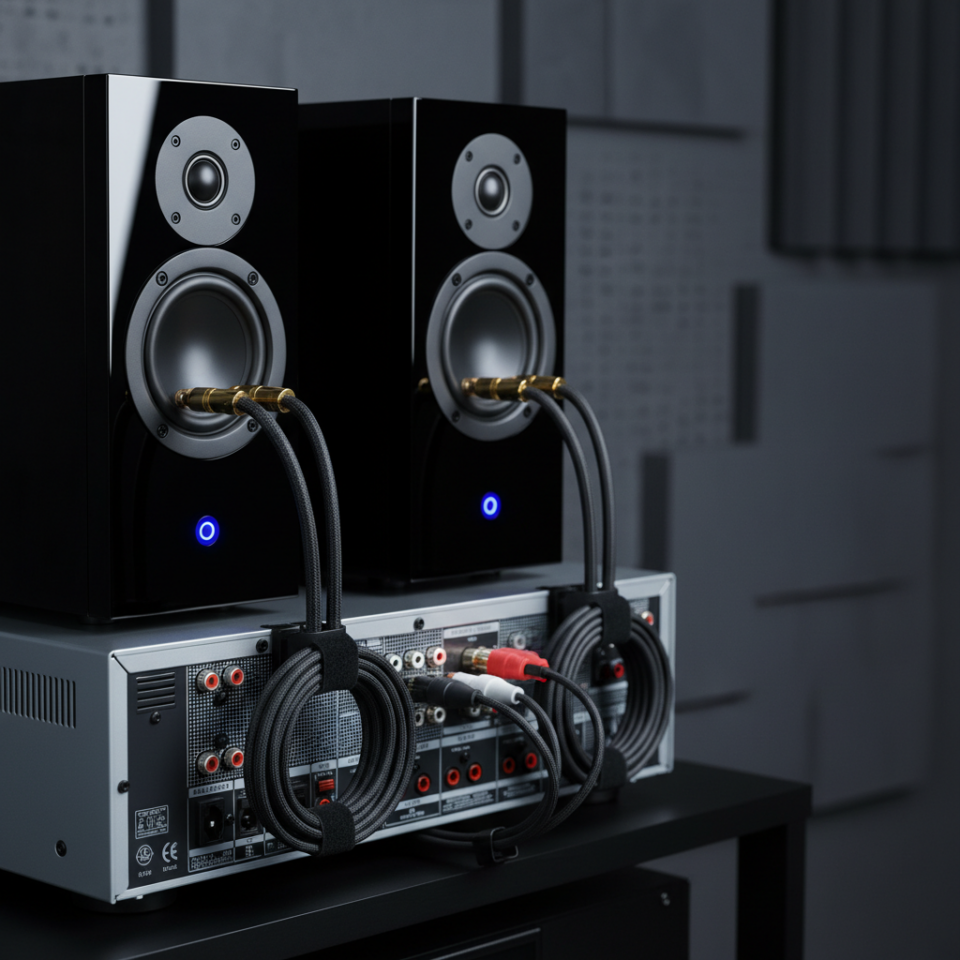
Setting up a home theater or a quality stereo system can seem daunting, especially when faced with a tangle of wires and an array of ports on your Audio/Video (AV) receiver. Many new users find themselves scratching their heads, wondering which cable goes where to get that perfect sound. This guide simplifies the process of connecting your speakers to an AV receiver, ensuring you achieve rich, immersive audio without frustration. We’ll focus on common home theater setups, using simple language to get you up and running quickly and correctly.
Understanding Your AV Receiver and Speaker Connections
At its heart, an AV receiver acts as the brain of your home audio system. It receives audio and video signals from various sources (like a Blu-ray player, streaming device, or gaming console), processes them, and then sends the audio to your speakers and video to your TV. For our purposes, the most important part of the receiver is the back panel, where all the speaker connections are housed.
You’ll typically see a series of pairs of red and black terminals, often labeled “Front Left,” “Front Right,” “Center,” “Surround Left,” “Surround Right,” and sometimes “Surround Back” or “Height.” These labels correspond directly to the speaker you’ll connect. The red terminal is for the positive connection, and the black terminal is for the negative connection. Speakers also have corresponding red and black (or sometimes plain black and white) terminals. Maintaining this positive-to-positive and negative-to-negative connection is crucial for proper sound reproduction. Getting it wrong won’t usually damage your equipment, but it can make your speakers sound thin or “out of phase,” meaning the sound waves are slightly misaligned, reducing clarity and bass.
Choosing the Right Speaker Wire and Making Connections
The cable you’ll use to connect your speakers to the receiver is called speaker wire. It’s essentially two insulated strands of copper wire. Speaker wire comes in different thicknesses, measured in “gauge.” A lower gauge number means a thicker wire. For most home audio setups and typical speaker-to-receiver distances (under 50 feet), 16-gauge or 14-gauge speaker wire is perfectly adequate. Thicker wire (lower gauge) is generally better for longer runs or very powerful systems, as it reduces signal loss over distance.
Once you have your speaker wire, prepare it for connection. Most speaker wires have a clear plastic casing that you’ll need to strip back by about half an inch at each end to expose the bare copper wires. Be careful not to cut or nick the copper strands themselves. Many AV receivers and speakers use “banana plugs” for a more secure and convenient connection, but you can also directly insert the bare wire into the binding posts. If using bare wire, twist the exposed strands tightly to prevent stray wires from touching other terminals, which could cause a short circuit and potentially damage your amplifier.
When connecting, simply match the labeled speaker output on your receiver to the corresponding speaker. For example, connect the wire from the “Front Left” terminals on the receiver to your left front speaker. Ensure the red wire goes to the red terminal and the black wire to the black terminal on BOTH the receiver and the speaker. Double-check all connections before powering on your system.
Speaker Impedance: A Quick Note on Compatibility
One important factor to be aware of, though less critical than matching positive and negative, is speaker impedance. Impedance is a measure of the electrical resistance a speaker offers to the audio signal and is expressed in “ohms” (Ω). Most home audio speakers are rated at 8 ohms or 6 ohms. Your AV receiver will also have an impedance rating, usually indicating the range of speaker impedances it can safely drive (e.g., “6-16 ohms”).
It’s generally safe to connect speakers with a higher impedance than your receiver’s minimum rating (e.g., 8-ohm speakers to a receiver rated for 6-16 ohms). However, connecting speakers with a significantly *lower* impedance than your receiver’s minimum can put a strain on the receiver’s amplifier. This can cause the receiver to overheat, potentially leading to performance issues or even damage over time. Most modern receivers have protection circuits to prevent damage, but it’s always best to match impedances appropriately. For most users, simply ensuring your speakers are 6 ohms or 8 ohms will be compatible with the vast majority of AV receivers on the market.